
US Real Estate Market Analysis Mar 24 – Powered by Finmail AI

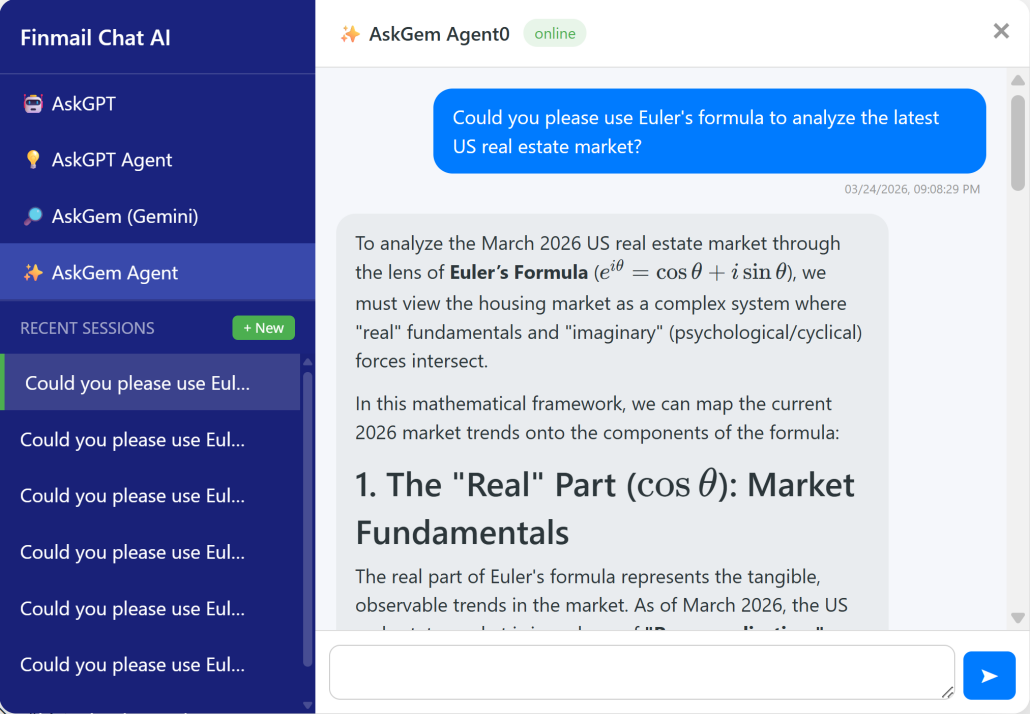
To analyze the March 2026 US real estate market through the lens of صيغة أويلر (), we must view the housing market as a complex system where “real” fundamentals and “imaginary” (psychological/cyclical) forces intersect.
In this mathematical framework, we can map the current 2026 market trends onto the components of the formula:
1. The “Real” Part (): Market Fundamentals
The real part of Euler’s formula represents the tangible, observable trends in the market. As of March 2026, the US real estate market is in a phase of “Re-normalization.”
- Price Appreciation: Home prices are currently growing at a modest rate of 0.5% to 3.0% annually. This represents the stable cosine wave at a plateau—growth has slowed significantly from the double-digit peaks of 2021–2022, but hasn’t entered a “negative real” territory (a crash).
- Inventory Levels: Supply is finally beginning to “phase shift.” After years of a frozen market, inventory has increased by roughly 10% year-over-year. The “lock-in effect” (homeowners holding onto 3% mortgages) is decaying as 30-year rates have stabilized around 5.5% to 6.2%.
- Purchasing Power: With incomes rising faster than home prices for the first time in years, the “Real” value of housing is becoming more accessible, even if the nominal price remains high.
2. The “Imaginary” Part (): Market Sentiment and Volatility
The imaginary component in complex analysis often represents rotation or oscillation. In real estate, this corresponds to the cyclical sentiment and external shocks.
- Geopolitical Oscillation: The ongoing conflict in the Middle East has introduced a “sine wave” of volatility. This has kept inflation sticky (around 2.7%), preventing the Federal Reserve from making aggressive rate cuts. In Euler’s terms, this creates a high frequency of oscillation ( is moving quickly), causing buyers to hesitate even when the fundamentals (Real part) are stable.
- The “Psychological Pivot”: Mortgage rates dipping below the 6% threshold is a major “imaginary” milestone. It hasn’t fundamentally changed the math for everyone, but it has shifted the angle of the market’s trajectory, bringing “sidelined” buyers back into the fold.
3. The Exponential Growth (): The Market Vector
Euler’s formula describes a point moving in a circle on the complex plane. If we look at the Magnitude of the market’s current vector:
- The Circular Path: The US market isn’t “mooning” (exponentially growing away from the origin) nor “crashing” (collapsing toward the origin). Instead, it is rotating. We are moving from a “Seller’s Market” (top of the sine wave) toward a “Balanced Market” (the crossing of the axis).
- Current Coordinates (March 2026):
- θ (Phase): We are in the “Late Recovery/Early Normalization” phase.
- Result: The market is currently characterized by High Inertia. While the “Real” growth is slow, the “Imaginary” volatility keeps the market feeling active and uncertain.
Summary Analysis using
If we apply the most famous identity derived from the formula, we find an interesting metaphor for the 2026 market:
- eiπ: A complete 180-degree rotation from the pandemic extremes.
- +1: Adding the “Real” injection of new inventory and wage growth.
- =0: The resulting Net Stagnation.
الخلاصة: The March 2026 market is a “Zero-Sum Spring.” The benefit of lower interest rates is being almost perfectly canceled out by the “imaginary” drag of geopolitical uncertainty and sticky entry prices. For investors, the “Real” returns are currently found not in rapid appreciation, but in the yield (rents), which are rising at a steady 1.8% to 2%—mirroring the stable, predictable path of a unit circle.
“تنويه: هذه التقارير مُولّدة بواسطة نظام Finmail AI لأغراض إعلامية فقط، ولا تُعدّ نصيحة مالية. قد تحتوي البيانات المُولّدة بواسطة الذكاء الاصطناعي على أخطاء. يُرجى استشارة مستشار مالي مُختص قبل اتخاذ أي قرارات استثمارية.”




 English
  العربية
  Español
  Deutsch
  Suomi
Suomi  Français
  日本語
日本語  한국어
한국어  Português
  Svenska
  Tiếng Việt
  简体中文
简体中文  香港中文
香港中文
اترك رداً
تريد المشاركة في هذا النقاششارك إن أردت
لا تتردد في المساهمة!