
تحليل سوق أسهم هانغ سينغ في هونغ كونغ، 24 مارس - مدعوم من Finmail AI
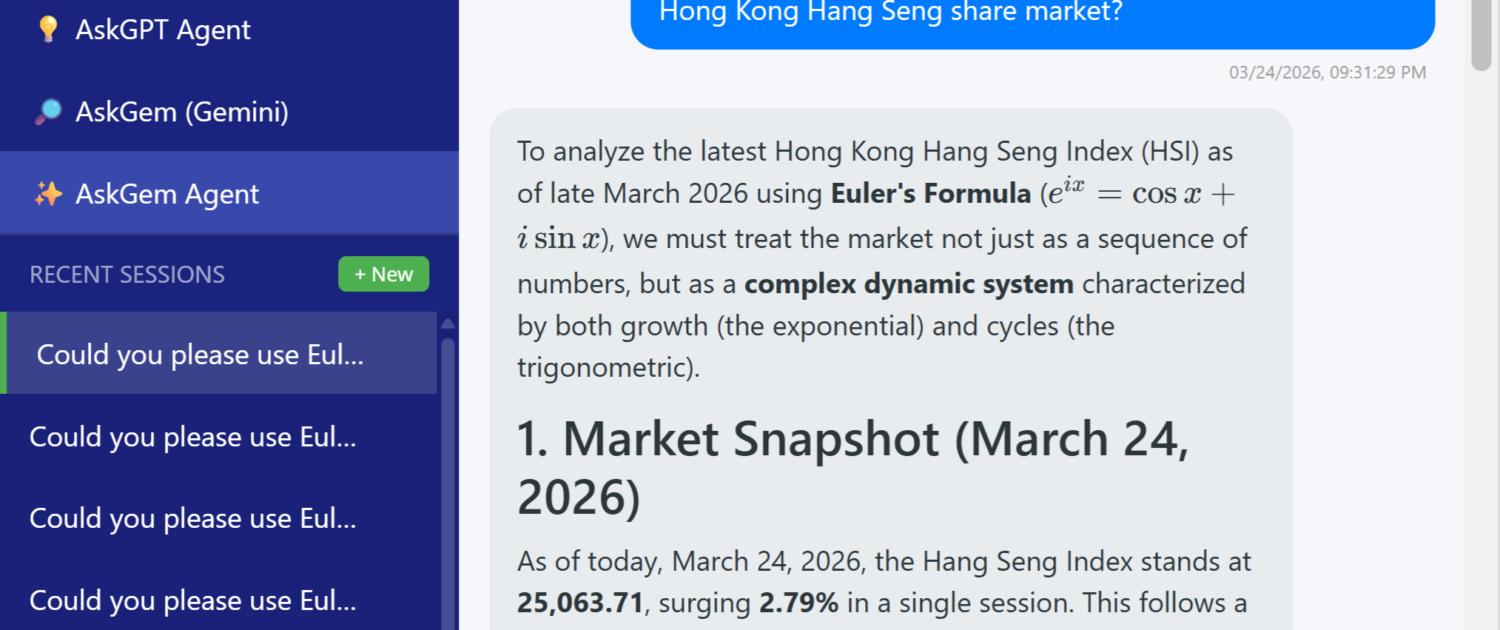
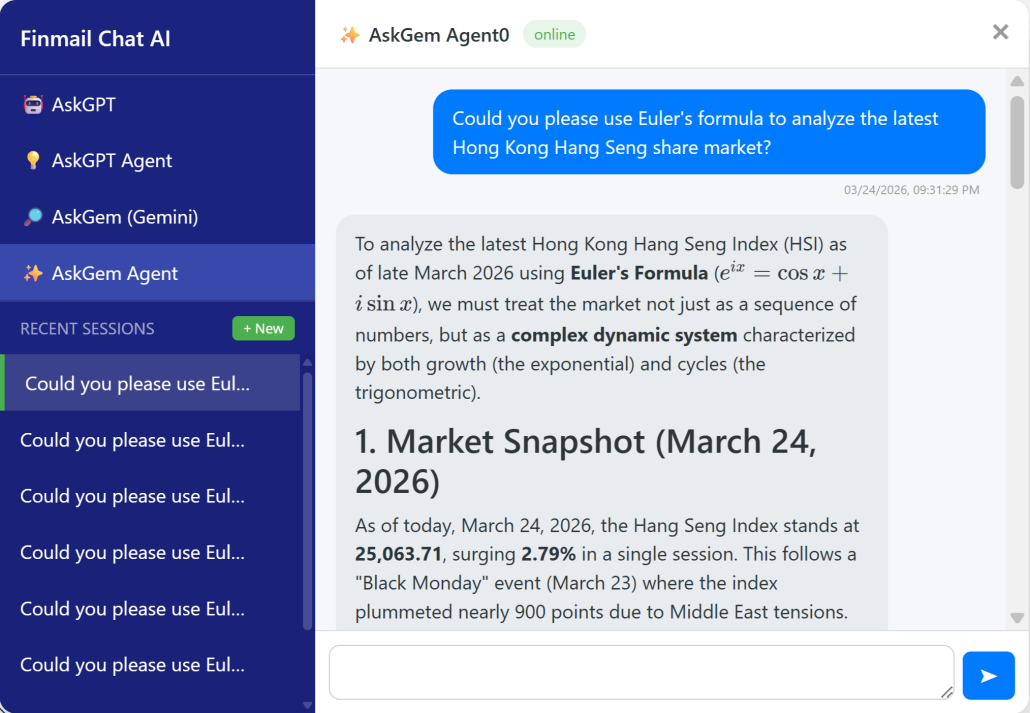
To analyze the latest Hong Kong Hang Seng Index (HSI) as of late March 2026 using Euler’s Formula (), we must treat the market not just as a sequence of numbers, but as a complex dynamic system characterized by both growth (the exponential) and cycles (the trigonometric).
1. Market Snapshot (March 24, 2026)
As of today, March 24, 2026, the Hang Seng Index stands at 25,063.71, surging 2.79% in a single session. This follows a “Black Monday” event (March 23) where the index plummeted nearly 900 points due to Middle East tensions.
2. The Mathematical Framework: Euler’s Formula in Finance
In quantitative finance, Euler’s formula is the bridge between linear growth و cyclical oscillation.
- eix: Represents the “phasor” or the rotating force of the market.
- cosx (The Real Part): Represents the actual, observable price action and fundamental value.
- isinx (The Imaginary Part): Represents market sentiment, volatility, and “latent” energy—forces that are not yet realized in the price but drive its movement.
3. Analysis of the Hang Seng Index
A. The Real Axis (): Tangible Recovery
The “Real” component of the HSI is currently driven by strong 2025 corporate earnings.
- The Catalyst: Companies like Laopu Gold (06181.HK) و Wuxi AppTec (02359.HK) reported profit surges, driving the 2.79% rebound.
- The Position: On the unit circle of Euler’s formula, the HSI has just pivoted from a “negative real” position (the 24,300 low on Monday) back toward the “positive real” side. This reflects a “bargain hunting” phase where the intrinsic value () outweighs the fear.
B. The Imaginary Axis (): Sentiment & Geopolitics
The “Imaginary” component in Euler’s formula handles the oscillations (the waves).
- Volatility (x): ال in our formula is currently high, driven by the frequency of geopolitical “noise.” The U.S.-Iran tensions acted as a massive imaginary shock, pushing the HSI into a volatile “complex” state.
- The Pivot: The rebound occurred because the “imaginary” fear (threat of strikes) was mitigated by “productive talks” and policy support from the PBoC (People’s Bank of China). In mathematical terms, the “phase angle” of the market sentiment shifted, allowing the price to rotate back toward growth.
C. The Exponential Growth (): Long-Term Vector
When we combine Euler’s formula with a real growth rate (), we get a spiraling growth model.
- The Target: Despite the 900-point drop yesterday, analysts maintain a year-end 2026 target of 28,300.
- The Analysis: The HSI is currently in a “damped oscillation.” The volatility (the sine/cosine waves) is high, but the underlying exponential vector () remains positive, supported by the shift of household deposits into wealth management products and a “revaluation” of the Technology and Real Estate sectors.
4. Conclusion: Where are we on the “Euler Circle”?
Using Euler’s identity (), we can view the market as a cycle of 0 to .
- Phase: We are currently at roughly 3π/2 in the short-term cycle—having hit a bottom (the “negative imaginary” peak of fear) and now rotating back toward the Real 1 (stability).
- Strategy: For investors, the “Euler Analysis” suggests that while the imaginary component (volatility) is creating massive swings, the real component (earnings) is stabilizing at a higher floor.
Latest Recommendation: Watch the 25,000-point level. If the HSI holds this “Real” support, the mathematical “momentum vector” suggests a continued rotation toward the 28,000 resistance zone by the third quarter of 2026.
“تنويه: هذه التقارير مُولّدة بواسطة نظام Finmail AI لأغراض إعلامية فقط، ولا تُعدّ نصيحة مالية. قد تحتوي البيانات المُولّدة بواسطة الذكاء الاصطناعي على أخطاء. يُرجى استشارة مستشار مالي مُختص قبل اتخاذ أي قرارات استثمارية.”



 English
  العربية
  Español
  Deutsch
  Suomi
Suomi  Français
  日本語
日本語  한국어
한국어  Português
  Svenska
  Tiếng Việt
  简体中文
简体中文  香港中文
香港中文
اترك رداً
تريد المشاركة في هذا النقاششارك إن أردت
لا تتردد في المساهمة!